A 76mm ID core is the three-inch hub that almost every label, film and thermal paper roll in the world is wound on. The nominal diameter is the easy part of the specification. What actually decides whether a core runs clean at 150 m/min — or tears a run apart with shaft slip, telescoping and web wander — is the tolerance stack hiding behind that number: bore roundness, wall consistency, cut squareness, and the grade of polymer it was extruded from.
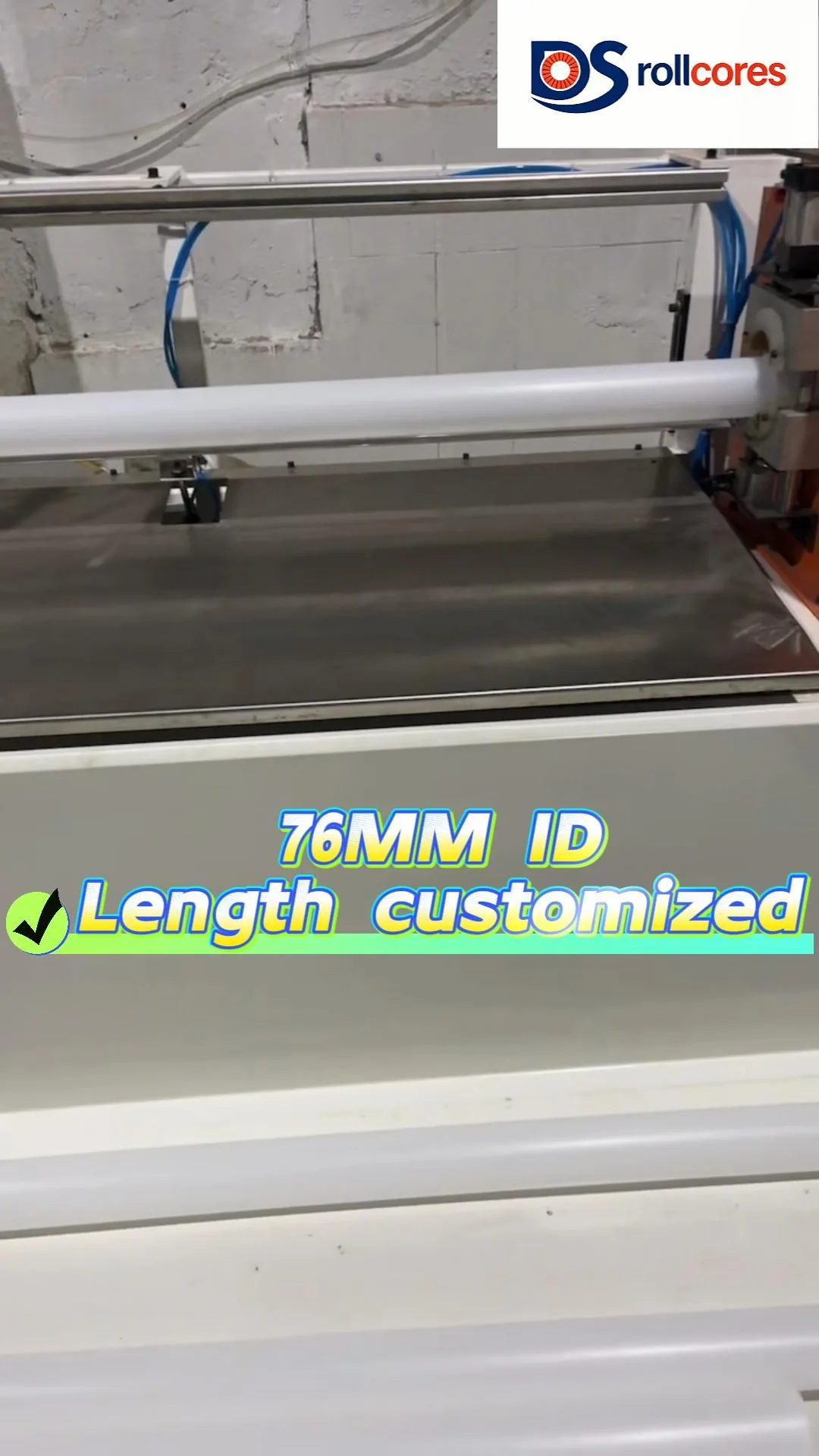
This guide covers the four decisions that matter when you buy 76mm cores — material, wall thickness, length and cut quality — plus the RFQ details that prevent the most common converting failures.
1. What “76mm ID” Actually Means — and Why 76 vs 76.2 Matters
The inner diameter (ID) is measured across the bore of the core, ignoring any chamfer at the ends. It is the single dimension that must mate with a 3-inch air shaft, mechanical chuck or expanding mandrel, so it is the one dimension you should never accept “close enough” on.
The industry uses two nominals that are not interchangeable in practice: 76.0mm (metric standard, used across most Asian and European converting lines) and 76.2mm (exactly 3.000 inches, the historical US standard). A 76.0mm bore on a 76.2mm shaft is a 0.2mm interference — tight enough to fight the shaft on loading and, on a bladder-type shaft, tight enough to split a core seam. Always quote the bore size on the drawing to one decimal place and state the shaft type it will run on.
| Parameter | Typical production tolerance | Why it matters |
|---|---|---|
| Inner diameter | 76.0mm +0.2 / −0.0 | Shaft fit; prevents slip and core crush |
| Bore roundness | ≤ 0.15mm | Even bladder pressure, no high-speed vibration |
| Wall thickness | 2.0–7.0mm ±0.2mm | Compression strength and OD consistency |
| Outer diameter | ID + 2 × wall | Chuck clearance on the winder |
| Length | ±0.5mm | Web edge alignment, fewer trim rejects |
| Cut squareness | ≤ 0.3mm deviation | Prevents roll “walk” and edge damage |
| Bore chamfer | 1–2mm × 45° | Fast, damage-free shaft entry |
| Material | 100% virgin PP, no regrind | Dimensional stability, low particle shed |
2. Core-to-Shaft Fit: The Silent Cause of Converting Waste
Most “core problems” reported on a converting line are actually fit problems. The failure modes fall into two camps:
- Too loose. The core rotates on the shaft instead of with it. You get slippage marks inside the bore, dust generation, tension spikes, and — on wide webs — telescoping as outer layers keep winding after the core has stopped.
- Too tight. The core has to be hammered on, the bore deforms, and the roll is no longer concentric. On light-wall cores this is how you get a star-cracked bore before the first metre is wound.
A 3-inch pneumatic shaft typically expands 1.5–3mm, so the target is a light push fit: the core should slide on by hand with the shaft deflated and lock firmly at 5–6 bar. If your cores are supplied at 76.0mm nominal, that fit is reliable. If they arrive at 76.5mm “for easier loading,” expect slip.
Field check: measure the bore at three points 120° apart at both ends of the core. A core that reads 76.1mm at one end and 76.4mm at the other is oval, not oversized — and it will vibrate at speed no matter how carefully it is loaded.
3. Wall Thickness and OD: Sizing the Core to the Roll
Outer diameter is not a free choice — it is derived: OD = ID + 2 × wall thickness. Wall thickness is what carries the compression load from winding tension and stacked roll weight, so it should be selected against roll mass, not habit.
| Finished roll weight | Recommended wall | Typical use |
|---|---|---|
| Up to 15 kg | 2.0mm | POS / ATM thermal paper, small label rolls |
| 15–40 kg | 2.5mm | Standard label stock, carbonless, receipt paper |
| 40–80 kg | 3.0mm | Wide-web labels, BOPP and PET film |
| 80–150 kg | 4.0mm or honeycomb | Industrial film, foil, master rolls |
| 150 kg+ (jumbo reels) | 5.0–7.0mm solid wall | Jumbo film, heavy foil, laminates |
Once you know ID, wall and finished OD, you can reverse-engineer how much material a roll will hold — useful when a customer specifies a diameter but needs a metre count:
all dimensions in mm, caliper = material thickness in mm
Worked example. A 76mm ID core with 3.0mm wall gives an OD of 82mm. Wound to 300mm OD with 0.080mm self-adhesive label stock: π × (300² − 76²) ÷ (4 × 0.08) ÷ 1000 ≈ 827 metres. Change the core wall to 4.0mm and you gain 2mm of winding radius — roughly 60 extra metres on the same finished diameter.
4. Why 100% Virgin PP Beats Regrind — and When Paper Still Wins
“Pure raw material” is not a marketing phrase; it is a measurable performance difference. Virgin polypropylene has a known, narrow melt-flow index, so every core in a batch shrinks by the same amount as it cools. Regrind — especially unblended, multi-source regrind — varies batch to batch, and that variation shows up as oval bores, wall drift and unpredictable stiffness.
| Property | Virgin PP | Regrind PP | Paper core | PP honeycomb |
|---|---|---|---|---|
| Moisture uptake | None | None | High — swells, loses strength | None |
| Particle shedding | Very low | Low–moderate | Dust and fibre release | Very low |
| Reuse cycles | 20–50+ | 10–30 | 1–3 | 20–50+ |
| Bore dimensional stability | Excellent | Good | Poor in humid air | Excellent |
| Crush resistance per kg | High | Medium | Medium | Highest |
| Recyclability | #5 PP stream | #5 PP stream | Repulpable | #5 PP stream |
For cleanroom-adjacent label lines, food-contact packaging and optical film, virgin PP is the only sensible option: no moisture to migrate into the adhesive, no fibre dust to print into the web, and a bore that stays round after a month in a humid warehouse. Our custom-length plastic roll cores are extruded from 100% prime resin for exactly this reason.
5. Custom Length: The Details That Cause Downtime
“Length customized” is where most suppliers get vague and most converters get burned. Four attributes define a usable cut:
- Length tolerance. ±0.5mm is the working standard. For narrow webs on high-speed lines, specify ±0.3mm; a 1mm overhang on a 25mm-wide core is 4% of the roll face and will show up as edge damage in transit.
- Squareness. The cut face must be perpendicular to the bore axis within 0.3mm across the wall. A skewed cut makes the roll oscillate on the shaft and loads one flange harder than the other.
- Burr and flash. A raised burr on the cut edge scores the web, catches in the unwinder guide and creates tear initiation points. Cores should be cut and deburred, not simply guillotined.
- End chamfer. Both the bore and the outer edge need a light chamfer — the bore so the shaft enters cleanly, the outer edge so the first wrap of film does not crease.
Length itself should generally match the web width exactly, or exceed it by 0–1mm where the slitter allows. Cores significantly longer than the web waste winding capacity and create unsupported overhang that collapses under stacking pressure.
Beyond geometry, custom length is also where branding is added: colour masterbatch to match a customer’s brand, laser or inkjet marking of length and batch, and notches or keyways for machines with drive lugs. We produce 76mm and 79mm PP cores to any length from a few centimetres to over a metre on the same line, which keeps tooling cost out of short runs.
6. Matching the Core to the Application
Self-adhesive label stock
76mm ID is the default hub for 3-inch label reels. The core must be dimensionally stable because the adhesive layer is sensitive to any bore deformation that changes winding tension across the width — a common source of “tight edges, slack centre” rolls.
Thermal paper, POS and ATM rolls
Small receipt rolls usually run on 13mm or 25mm cores, but 76mm ID cores dominate the master rolls that these are slit from — and they are standard on wide thermal printer and kiosk formats. Virgin PP is important here: paper cores in humid conditions transfer moisture into the thermal coating and shorten image life. See our extruded PP cores for thermal paper.
Film, foil and flexible packaging
BOPP, PET, PE and metallised film rolls are heavier and wound tighter, so wall thickness and crush resistance become the limiting factors. Honeycomb-wall PP cores deliver the same stiffness at lower weight, which reduces freight cost and operator fatigue on large-diameter rolls — the subject of our earlier piece on how PP honeycomb cores solve five label manufacturing challenges.
Carbonless and security paper
Multi-part carbonless needs a core that will not creep under sustained tension during long storage. A 2.5–3.0mm wall with tight roundness holds tension far better than the thin paper cores often substituted to save cost.
7. Quality Control: What to Audit, Not Just What to Ask
Any supplier will tell you their cores are precise. The difference is whether they can show you the measurements. A credible 76mm core programme includes:
- Incoming resin verification — grade certificate and a no-regrind declaration, batch by batch.
- First-article inspection — ID, ID roundness, wall, OD, length, squareness recorded on a dimensional report before the run is released.
- In-process sampling — dimensional checks at defined intervals, not only at the end of the shift.
- Compression test — a radial crush check that predicts performance under stacked storage, especially for 3.0mm and 4.0mm walls.
- Traceability — batch code linking finished cores back to resin lot and extrusion date.
Ask for the inspection report with the first shipment. If a supplier cannot produce one for a 76mm core with a stated ID tolerance, the tolerance is aspirational.
8. How to Write a 76mm Core RFQ
Send this and you will get comparable quotes instead of vague ones:
Inner diameter: 76.0mm +0.2/-0.0, bore roundness ≤0.15mm
Wall thickness: 3.0mm ±0.2mm | Resulting OD: 82mm
Length: 330mm ±0.5mm, squareness ≤0.3mm
Material: 100% virgin PP, white, no regrind
Ends: bore chamfer 1.5×45°, deburred
Marking: batch code inkjet inside bore
Quantity: 5,000 pcs/month, 3 shipments
Destination: [port] | Packaging: woven bag + pallet
Required documents: dimensional inspection report, material certificate
9. Packaging, Lead Time and Volume
76mm cores are bulky rather than heavy, so packaging decisions drive freight cost more than material cost. Standard practice is bundled in PP woven bags or cartons on export pallets, with lengths over 600mm crated to prevent bowing in transit. Order in monthly container quantities where possible — the per-unit saving on extrusion runs is significant compared with mixed, small-batch orders.
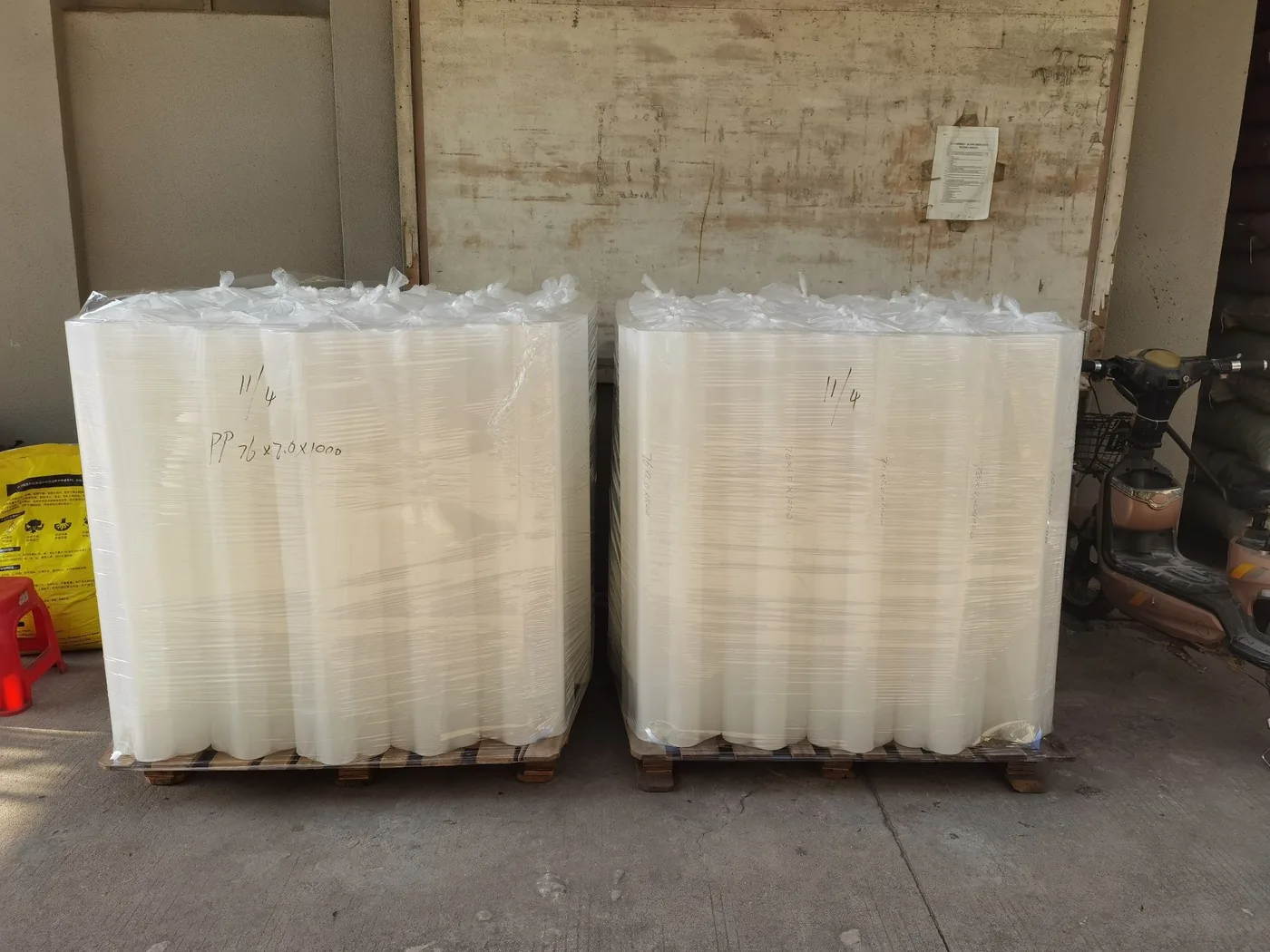
Typical production lead time for custom lengths is 7–15 working days after drawing approval, with sample cores dispatched within one week. Because the length is cut, not moulded, there is no tooling charge for a new size — which makes 76mm cores practical for trial orders as well as annual contracts.
10. Frequently Asked Questions
Not exactly. 3 inches is 76.2mm. The two are interchangeable on most expanding shafts, but a 76.0mm core on a 76.2mm fixed mandrel is a 0.2mm press fit. Always confirm the bore to one decimal place and match it to your shaft type.
Yes. Length is set at the cutting station rather than by a mould, so any length within the line’s capacity is available — typically 30mm to 1,200mm — at ±0.5mm tolerance, without tooling cost.
As a rule of thumb: 2.5mm up to 40kg, 3.0mm to 80kg, 4.0mm or a honeycomb structure above that. Winding tension and storage duration matter as much as weight — share both when you request a quote.
PP for anything humidity-sensitive, reusable, or running at speed. Paper remains appropriate for single-trip, repulpable, low-tension applications where cost is the dominant factor.
Yes. Virgin PP cores are a clean #5 polypropylene stream and can be reground or recycled with other PP packaging. They are also reusable for 20–50 cycles, which usually beats recycling on both cost and carbon.
Sample cores in standard 76mm ID sizes are available for evaluation; custom lengths are sampled against the approved drawing. Freight is normally at the buyer’s account and credited against the first production order.
Need 76mm ID cores to your exact length?
Send your drawing, shaft type and monthly volume — we will come back with dimensions, wall options and a factory-direct quotation within one working day.
Request a QuotePrefer to see the cores before you buy? Watch our extrusion, cutting and packing lines in action on TikTok — @dsrollcores.facto.