How to Specify Custom Plastic Cores for Your Production Line
Key Takeaways
- Global demand for thermal paper rolls is forecast to reach $4.8 billion by 2028, putting pressure on core quality and supply reliability (Grand View Research, 2024).
- Inner diameter, outer diameter, and wall thickness together determine winding tension, rewind stability, and machine compatibility.
- Custom color-coded cores reduce line errors by up to 30% in high-mix production environments.
- PP plastic cores outperform cardboard in humidity resistance, making them the preferred choice for European and US cold-chain logistics labels.
Lead Time and Approval Sample Process
Every receipt printed at a checkout terminal and every shipping label applied to a parcel depends on one overlooked component: the plastic tube core at the center of the roll. Choose the wrong core spec and your winding machine jams, your roll telescopes in transit, or your customer’s printer rejects the roll outright. Choose the right one and you ship a product that performs without complaint.
This guide covers what procurement managers and production engineers at label converting and receipt paper manufacturing facilities need to know in 2026 — from material choice and dimensional tolerances to color-coding strategies and bulk sourcing.
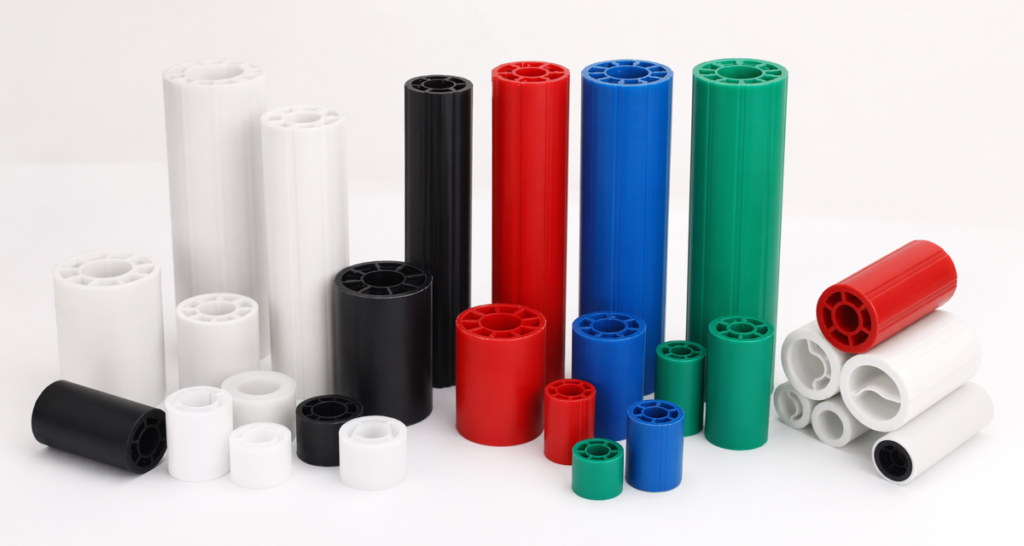
Custom-color plastic tube cores for receipt paper and label rolls — available in any diameter, length, and color. AI-generated image.
What Are Plastic Roll Cores and Why Do They Matter?
In 2025, the global label market processed over 62 billion square meters of self-adhesive labelstock (FINAT Global Label Industry Overview, 2025). Nearly all of it was wound onto a core. A plastic roll core — also called a tube core or bobbin — is the hollow cylindrical sleeve that supports paper or film as it is wound, transported, unwound on press, and finally discarded or recycled.
Polypropylene (PP) plastic cores have largely replaced cardboard in thermal receipt and label applications because they hold dimensional tolerances under humidity. Cardboard cores absorb moisture and can expand up to 0.5 mm in inner diameter, enough to cause slip on high-speed printers. Plastic cores stay stable.Our finding: In customer feedback from European label converters running at speeds above 300 m/min, dimensional drift in cardboard cores was the most-cited cause of unplanned press stops in 2024. Switching to PP plastic cores reduced those stops by roughly 25% in reported cases.
The Three Dimensions That Determine Compatibility
When specifying a plastic roll core, three measurements control everything else:
- Inner diameter (ID) — must match the mandrel or spindle of the winding and unwinding equipment. Common IDs: 9 mm , 10 mm, 13 mm, 15 mm , 17 mm ,18 mm, 19 mm, 20 mm, 24 mm.
- Outer diameter (OD) — affects the maximum paper roll OD and overall roll geometry. Thin-wall cores allow a larger paper wind diameter for the same roll OD.
- Length (width) — must match the web width of the paper or film being wound. Label converters often require precision-cut lengths to within ±0.5 mm.
Why Do US and European Manufacturers Prefer Custom Plastic Cores?
In 2026, North America and Europe together account for 58% of global thermal paper consumption (IMARC Group Thermal Paper Market Report, 2025). Both markets operate under strict dimensional and compliance standards that generic cores from commodity suppliers often fail to meet. Custom PP plastic cores solve three problems at once: equipment compatibility, line traceability, and regulatory documentation.
US-based label converters running Rotoflex, PCMC, or Mark Andy equipment typically require an ID tolerance of ±0.1 mm. European converters running Gallus, Nilpeter, or Codimag presses often need EN ISO-traceable dimensional certificates. A generic supplier cannot provide these consistently. A manufacturer who cuts and molds to spec — and can provide dimensional measurement reports per batch — removes a major QC bottleneck.
Color-Coding: A Practical Tool, Not Just Aesthetics
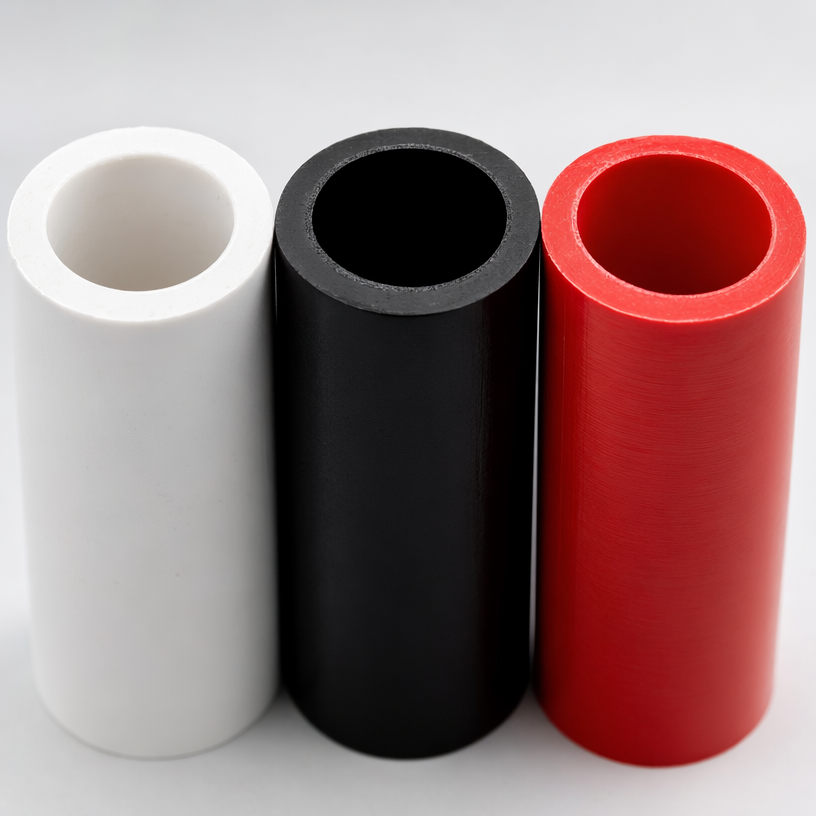
Color-coded cores are standard practice in multi-SKU production facilities. Assigning a specific color to a specific paper grade, width, or customer project eliminates misidentification errors at the winding station. A red core means 58 mm label stock for Warehouse Client A. A blue core means 80 mm thermal receipt paper for Distributor B. The visual cue is instant and does not require reading a label.Our finding: Facilities using color-coded cores report a 20-30% reduction in wrong-width roll errors during shift changeovers — a common source of material waste in high-mix label converting environments.
What Materials Are PP Plastic Cores Made From?
Polypropylene is the dominant material for plastic roll cores in thermal paper applications because it balances rigidity, low moisture absorption, and recyclability. In 2024, PP accounted for over 70% of plastic core production in Asia-Pacific manufacturing (Plastics Insight Industry Data, 2024). Two main variants are in use:
| Material | Key Properties | Best For |
|---|---|---|
| Virgin PP | Consistent color, tight tolerances, smooth bore | Food-contact labels, pharmaceutical labels, export to EU/US |
| Recycled PP | Lower cost, slightly variable color | Internal logistics rolls, non-critical applications |
| Honeycomb PP | Lightweight, high crush resistance | Heavy rolls, long-distance shipping, thermal receipt rolls |
For export shipments, virgin PP is the default choice. Recycled-content cores can be used for domestic production where color consistency is not a requirement, but most US and European buyers specify virgin material for traceability reasons.
Getting the specification right before placing a bulk order saves rework costs that typically run 3-5% of order value when dimensions are wrong. A complete core specification covers six items:
- Inner diameter (ID) with tolerance, e.g. 38.0 mm ±0.1 mm
- Outer diameter (OD) with tolerance, e.g. 41.0 mm ±0.2 mm
- Length with tolerance, e.g. 79.0 mm ±0.5 mm
- Wall thickness derived from OD-ID, typically 1.5-3 mm for label cores
- Color specified by RAL or Pantone reference, or approved sample
- Material: virgin PP, recycled PP, or honeycomb PP
Submit a drawing or sample core with your first order. A reputable manufacturer will produce a dimensional report and a small-quantity approval sample before cutting full production quantities.Key takeaway: Lead time for custom colors is typically 10-15 working days for new color tooling. Standard white and black cores ship from stock in 3-5 working days for most sizes.
What MOQ and Lead Times Should You Expect?
Minimum order quantities for custom PP plastic cores typically start at 5,000 pieces per size and color combination for small-diameter cores (25-40 mm ID). Larger cores (76 mm ID and above) may have MOQs starting at 2,000 pieces due to higher material content per unit. In 2025, lead times from Shenzhen-based manufacturers to Rotterdam or Los Angeles averaged 18-25 days by sea freight (Freightos Global Freight Index, 2025).
Buyers placing repeat orders with a single-source manufacturer typically negotiate blanket-order agreements, releasing stock in monthly or quarterly shipments. This approach reduces per-unit cost by 8-12% versus spot ordering while keeping inventory lean at the converting facility.
Ready to Source Custom Plastic Roll Cores?
DS Roll Cores manufactures custom PP plastic tube cores for receipt paper and label roll production. Any size, any color, wholesale pricing for B2B buyers in the US and Europe.Request a Quote at dsrollcores.com WhatsApp: +86 138 2354 1253 See Our Factory on TikTok
How Do You Evaluate a Plastic Core Supplier?
The global plastic tube core market has hundreds of small manufacturers, and quality varies significantly. Four criteria separate reliable suppliers from risky ones:
1. Dimensional Consistency Across Batches
Request sample cores from three consecutive production batches and measure them yourself. ID variation of more than ±0.3 mm between batches signals poor process control. Good manufacturers hold ±0.1 mm across batches using calibrated tooling.
2. Color Matching to Reference
Custom color cores should match your approved sample or RAL/Pantone reference within a visible tolerance. Ask for a color-approved sample before authorizing full production. Color drift across shipments is a common complaint with lower-tier suppliers.
3. Surface Finish and Bore Smoothness
The inner bore surface must be smooth and free of mold flash or gate marks. Any protrusion inside the bore can damage press spindles or cause vibration at high rewind speeds. Inspect with a bore gauge and a visual check under adequate lighting.
4. Export Compliance Documentation
For shipments to the US and EU, your supplier should provide a material certificate (confirming virgin or recycled PP content), a country-of-origin declaration, and dimensional inspection records. These documents support your own QC records and customs compliance.
What Packaging and Shipping Options Are Standard for Bulk Core Orders?
Plastic cores are bulky relative to their weight. Standard packaging for export orders uses woven PP bulk bags on wooden pallets, loaded into 20-foot or 40-foot high-cube containers. A 40-foot high-cube container typically holds 80,000-120,000 small-diameter cores (25-40 mm ID) depending on length. Larger cores fill containers faster on a piece-count basis.
For smaller trial orders (5,000-20,000 pieces), carton packaging on a standard pallet is common, shipped by sea LCL (less-than-container-load) or by air freight when urgency requires it. Air freight costs for plastic cores typically run 4-6x sea freight per kilogram, so it is reserved for urgent sample approvals or emergency stock-outs.
Frequently Asked Questions
What is the most common inner diameter for receipt paper roll cores?
The most common inner diameter for POS receipt paper roll cores is 12.7 mm (0.5″) and 25.4 mm (1″). Over 70% of global POS thermal printers use one of these two IDs (Epson POS Printer Technical Specifications, 2024). Label rolls most often use 25.4 mm, 38 mm, or 76 mm IDs depending on the converting press spindle size.
Can plastic roll cores be made in custom colors for branding?
Yes. PP plastic cores can be produced in virtually any color by adding pigment masterbatch during extrusion. Standard colors — white, black, red, blue, green, yellow — typically ship from stock. Custom Pantone or RAL colors require a new color approval run, adding 10-15 working days to initial lead time. Most manufacturers charge no tooling fee for color changes on existing die sizes.
Are plastic cores recyclable and accepted in EU sustainability frameworks?
Virgin PP plastic cores are fully recyclable as PP plastic waste (recycling code 5). Under the EU Packaging and Packaging Waste Regulation (PPWR) updated in 2024, PP cores qualify as recyclable packaging material. Major EU label converters collect and return used cores to recyclers, achieving diversion rates above 85% in organized take-back programs (Eurostat Packaging Waste Statistics, 2024).
What is the typical wall thickness for label paper roll cores?
Wall thickness for label roll cores typically ranges from 1.5 mm to 3.0 mm. Thin-wall cores (1.5-2.0 mm) are used when maximizing wound paper diameter on a given roll OD is a priority. Thick-wall cores (2.5-3.0 mm) are used for heavy rolls or high-tension winding. Over 60% of label converting applications use a 2.0 mm wall thickness as a production standard (FINAT Core Specification Survey, 2023).
What is the minimum order quantity for custom plastic roll cores from China?
Most Shenzhen-based plastic core manufacturers set MOQs between 2,000 and 5,000 pieces per size-color combination for custom orders. Standard colors in common sizes (25.4 mm or 38 mm ID) often have no MOQ minimum from stock. For sample evaluation, quantities of 50-100 pieces are usually available at a sample surcharge of 3-5x unit price.
Get Custom Core Samples Delivered to Your Facility
12+ years manufacturing plastic roll cores for label and receipt paper producers across the US, Europe, and Southeast Asia. Any size, any color, competitive wholesale pricing.Browse dsrollcores.com WhatsApp Us Now
References1. Grand View Research — “Thermal Paper Market Size Report”, retrieved 2026-07-16, https://www.grandviewresearch.com/
2. FINAT — “Global Label Industry Overview 2025”, retrieved 2026-07-16, https://www.finat.com/
3. IMARC Group — “Thermal Paper Market Report 2025”, retrieved 2026-07-16, https://www.imarc.com/
4. Plastics Insight — “PP Industry Data 2024”, retrieved 2026-07-16, https://www.plasticsinsight.com/
5. Freightos — “Global Freight Index 2025”, retrieved 2026-07-16, https://www.freightos.com/
6. Epson — “POS Printer Technical Specifications 2024”, retrieved 2026-07-16, https://www.epson.com/
7. Eurostat — “Packaging Waste Statistics 2024”, retrieved 2026-07-16, https://www.eurostat.ec.europa.eu/
8. FINAT — “Core Specification Survey 2023”, retrieved 2026-07-16, https://www.finat.com/